
You’re being asked to lead AI and control almost none of it.
Two mornings with 15 people in the same spot. You leave with a nine-dimension read of where your organization stands, one move scoped down to something you can get a yes on, and a 90-second version you’ve said out loud to a room that pushed back.
October wraps on the 13th, while most 2027 budgets are still being written. A move scoped that week can still go in as a line item.
December is the Q1 cohort. Budgets are set by then, so the room works on what you can move with what you already have.
Two cohorts open
October cohort
Tuesdays, Oct 6 + Oct 13, 2026
December cohort
Tuesdays, Dec 8 + Dec 15, 2026
What I call Random Acts of AI
Last cohort, a Director of AI Enablement at a multinational beverage company told me they’d turned Copilot on for the whole company. Big rollout. What came back? Proofread emails. Most people never opened it again.
Someone else counted twenty or thirty proofs of concept inside one support organization. All solving the same problem. Nobody knew, because nobody could see them.
A third had a dozen pilots running at once and none of them finishing.
And in the fourth, only the developers had AI access. So whatever the rest of the company was figuring out, nobody upstairs ever saw it.
Four organizations, plenty of AI. That’s what I call Random Acts of AI: activity everywhere, and nothing carrying one team’s win to the next. Every team starts over.
Sound familiar? I’d bet you’ve got a version of it. And I’d bet you got handed the mandate without the budget line or the decision rights to go with it. (Am I close?)
Building those connections is what we work on across the two mornings.
You’re responsible for AI spreading, and you don’t control the org chart.
VPs of transformation. Chief AI officers. PMO and EPMO leads. VPs of technology. AI enablement leads. People who got handed the mandate last week. Consultants carrying it inside a client. Insurance, logistics, CPG, healthcare, financial services.
The titles vary. The condition is the same. Most people arrive with progress they’re looking to amplify. It works whether you’re inside the organization or advising one.
One thing surprised me last cohort. Of the eleven moves people scoped, ten were about getting permission, funding or a decision. Only one was about building something. If your hard part is getting the yes, you’re in the right room.
Three things you leave with
Nine dimensions instead of the two or three you’ve been watching. Where you’re strong, where you’re stuck, which two are pulling hardest against each other, and what that gap costs you.
You bring the move you already care about. The room cuts it down, names the evidence it still needs, and you leave with a short written version and a person who’ll ask you about it in three weeks.
A plan without buy-in doesn’t go anywhere, so you pitch yours and the room tells you where it falls apart. A CEO in the last cohort heard her own pitch back and realized she was still missing the data she needed before making it.
Where your organization stands, across nine dimensions
Nine things have to move together for an organization to become AI native. Most leaders I talk with are tracking two or three of them.
In session one, an AI interviews you by voice across all nine. It asks for evidence, pushes back when you’re vague, scores you through five stages, and then asks whether it got you right. You get to argue with it. Plenty of people do.
The nine: AI impact, the linear organization, organizational structure, budgeting and incentives, leadership, roles, sensing, decision-making, and adaptation and learning.
You’ll leave with a map of where you sit, your full written report, and the two dimensions pulling hardest against each other.
Two working sessions, three hours each
I call it a learning arena. Structured conversations where you build your plan and the room pressure-tests it. Who could stop this? Who can help? A plan without buy-in doesn’t go anywhere.
Two minutes on what happens in the room.
Where you stand
The nine dimensions · Your terrain read, by voice · The move you’ll bring back
Between. Async office hours. Optional, recorded.
The move, and the blind spots that would sink it
Your move, pressure-tested by a peer · Where it stalls, and who can stall it · A 90-second version you say out loud
Virtual. Zoom link on enrollment.
See the full hour-by-hour agenda
Who’s been in the room, and what they did with it
One participant walked out having decided to convert his company’s AI program from something he ran on the side into a funded function with named ownership and real decision rights.
A global insurer · a Fortune 500 beverage company · a national logistics carrier · Google · a fintech payments platform
“Taking the assessment, bringing in our current plan, then looking at the places we needed more ideas, where we needed to progress. And we collaborated.”Billie Schuttpelz, CEO, Metaverse Enterprises
“I am so happy to be in this cohort. I don’t want it to end. I am getting such great insights from you and the other cohort members.”Ann Stewart Zachwieja, COO, intuist.ai
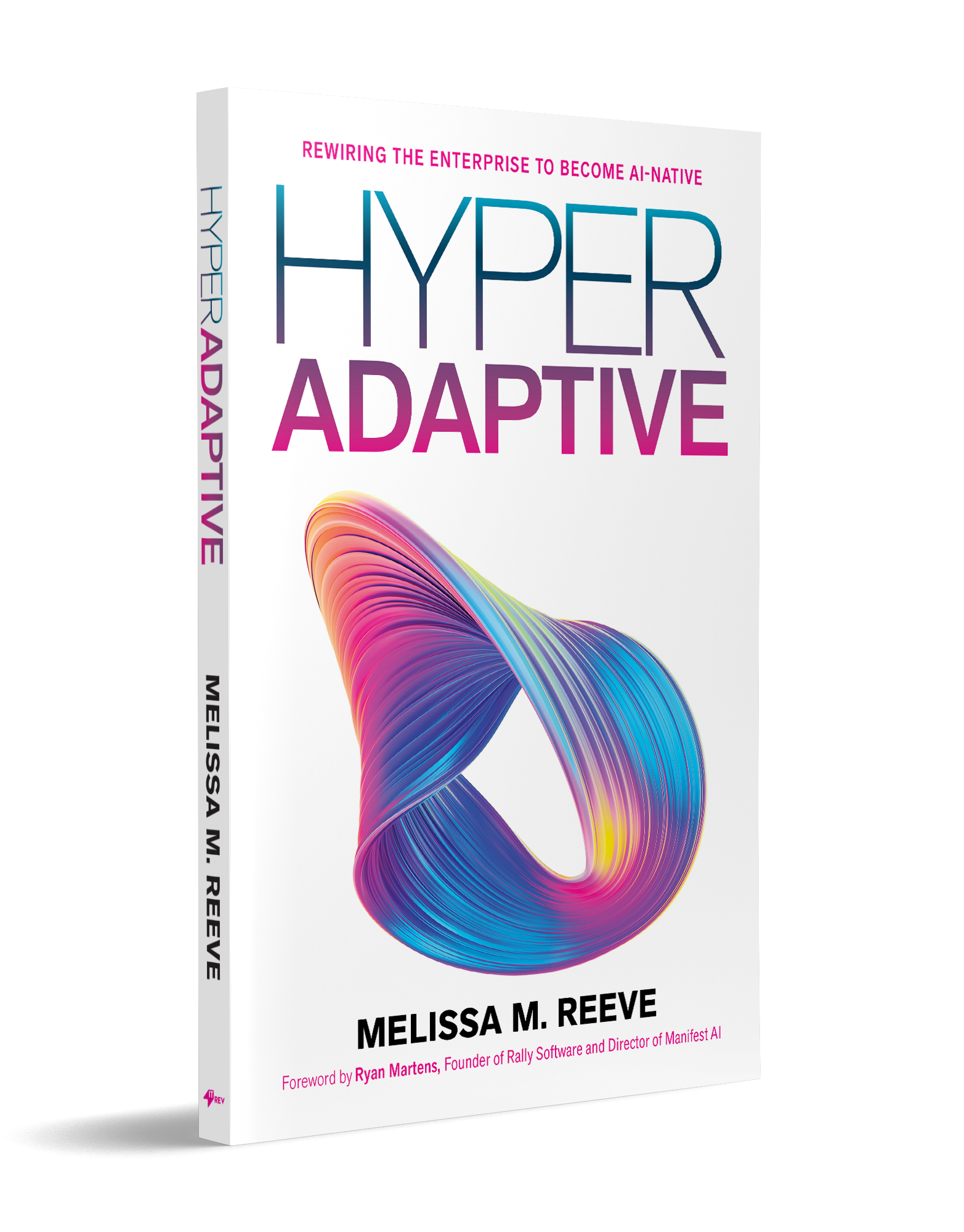
Hyperadaptive: Rewiring the Enterprise to Become AI-Native
IT Revolution Press · Simon & Schuster.
Built on thirty years of systems and change research (Senge, Kotter, the Toyota Production System) and twenty-five years of running transformations. Then written down and published. What’s on the page is what happens in the room.
What $797 covers
- Both mornings, six hours of working time.
- Your terrain assessment and the full written report.
- A one-on-one strategy session with me ($1,500 on its own).
- Six months of the paid Substack community ($150).
- The prompt pack and the AI Learning Flywheel ebook ($150).
Bought separately, that’s $1,800. In the cohort it’s $797, and I cap it at 15 so everyone gets worked on, not just talked at.
$797 is an introductory price. It holds through the end of this year.
If there’s training budget left in yours, this is what it’s for.
How this compares
| Option | Cost | Time | You leave with |
|---|---|---|---|
| A consultancy AI readiness assessment | $50K and up | 6–12 weeks | Their read of your organization, and a proposal for phase two |
| An executive AI program (university or online) | $3K–$10K | 4–8 weeks | Frameworks and a certificate. Nothing scored on your own org |
| A peer roundtable membership | ~$5K a year | Ongoing | Good conversation, no assessment, no move |
| The book on its own | ~$28 | A weekend | The method, with you doing all the work of applying it |
| Free “AI advisory” from a vendor | $0 | An hour | A demo, and a quote |
| Doing it yourself | Your time | Months | Depends on what you already know, and who pushes back on you |
| This cohort | $797 | Two mornings | A nine-dimension read of your own organization, a written report, and one move your peers have already pressure-tested |
I'd like to enroll in a two-morning working cohort, Oct 6 and 13, 9 to 12 MT, $797. I come back with a nine-dimension read of where we stand on AI, a written report, and one move already scoped and pressure-tested by peers, so it arrives ready for a decision. It's built on the book Hyperadaptive (IT Revolution Press) and runs virtual, so no travel. If session one doesn't land, it's refunded.
Bring it to your own leadership team
Same two sessions, your people only. Everyone reads the same nine dimensions on the same organization, so the argument about where you stand happens in one room over two mornings. I teach it.
Ask about a private cohortFAQs
Is this training or consulting?
Neither. You use the instrument on your own organization, in the room, with peers who’ll tell you when your reasoning is thin. You leave with your work, not mine.
I’m a consultant. Does this work without my own organization?
Yes. Six people did exactly that last cohort. You map a client instead of an employer.
We’ve barely started. Am I too early?
Probably not. A stage-one read across all nine dimensions tells you which one to start with, instead of leaving you to guess.
Do I need to have read the book?
No, and it isn’t required at any point. Everything you need is in the room. Reading it will deepen the second session if you get to it.
What if I miss a session?
The main sessions are recorded and you keep access. Breakouts aren’t recorded, so the peer conversations are the part worth showing up live for.
Can we run this for our own team?
Yes. It’s the same two sessions with your people only, up to 15 leaders, and I teach it. Ask about a private cohort.
Enroll.
$797. Both mornings, your assessment and report, the strategy session, the Substack membership, and the prompt pack.
Click enroll and you’ll go to Stripe to pay. Zoom links follow by email.