

The model
What is the Hyperadaptive™ Model?
Most organizations buy AI as licenses. This model treats AI as a system your organization runs, and it names what has to move: nine dimensions of the organization, together, through five stages. What you're left with is five capabilities that hold after today's models are old news.
What you've built
You have a council, a policy, and people who raised their hand to be AI champions. They're motivated, they're close to the work, and they're getting results in their own corners.
The thing most likely holding you back
There's no structure under the enthusiasm. Nobody's role says 'carry this to the next team,' so a win stays with the team that had it, governance stays a document, and the agents nobody named keep running.
We've made this kind of investment before
In the 1990s we put a powerful new machine on every desk. Then we built everything around it: a help desk, a training budget, a procurement process, an IT department, a whole job family that hadn't existed. The machine was the cheap part.
AI is the same shape of investment, and nobody has drawn the org chart for it yet. This model is my attempt at drawing it.
There's a shift underneath that. We used to manage change as an event: a program, a go-live, a date when the transformation was finished. AI has no such date. The models update every few months, and each update opens work that wasn't possible the month before, so what you're managing now is a flow of change that doesn't stop.
The usual first fixes
Each of these is a real move, and each one runs out on its own.
A Chief AI Officer gives AI an owner, a budget and a seat at the table. Good call. It's also one person against a few thousand workflows.
A council can set the rules. It can't be in the room when someone in claims decides whether to let an agent draft the letter this time.
A platform can list every agent and who built it. Whether an agent still earns its keep is a judgment call, and judgment lives with the people who know the work.
The activation layer
What is the activation layer?
It's the layer between your AI strategy and the person doing the work. A short motion video explains it better than I can in a paragraph. Transcript below, if you'd rather read.
An activation hub sounds like this: "I'm the hub for claims. The new model landed last week. Here's what it changes for us, and here's what we're holding off on." That's it. Someone whose job is to translate what's new into what it means here.
Read the transcript
Hi, I'm Melissa Reeve, author of the best-selling book Hyperadaptive. If you're like most leaders, you can see AI's potential clearly. What's harder to see is the return. The gap between AI's potential and actual ROI keeps showing up across the industry, and it comes down to one thing: whether your people are activated in a meaningful, ongoing way.
Crossing that gap takes more than a training event, because AI continually rewires how your organization operates. What changed last quarter will change again next quarter. You need an activation system, one that can keep updating your organization as fast as the technology is changing. So what does that activation system look like?
It starts from how learning naturally spreads, person to person inside the work itself. Build on that, and you get a system that keeps itself current. This is what I call the AI learning flywheel. Let me show you how it turns.
Everything starts with a real workflow. In the Applied AI Workshop, a frontline team puts one of their own workflows on the table, scoped to fit the time at hand. They learn to map that workflow, spot the friction, and find the highest value places where AI can help. Then they build real solutions right there in the room, for problems they actually face. They walk out with durable skills, knowing how to analyze any workflow, find the AI opportunities inside it, and focus on the highest value use cases. The tools will keep changing, but the skills will serve them for years.
Every workshop reveals people who lean in. These are your future AI leads. They aren't necessarily your most senior or most technical people, but they're the natural connectors, the ones who can influence without authority, work through resistance, and teach what they know. Through the AI Leads Accelerator program, we give them real training chops, and they begin running Applied AI Workshops themselves. That's when AI literacy really starts to scale, because learning travels through trusted peers with local context.
As the wheel picks up speed, it needs an axle. That's the AI activation hub, a named function with a clear charter, and it's fractal by design. A smaller organization might have one, and a global enterprise might have dozens spread across functions and business units. Each hub has five main roles. It runs the train-the-trainer programs that prepare your AI leads to spread knowledge. It reduces cognitive load by tracking the latest AI developments. It creates micro-learning that leads can put straight into a practitioner's hands. It measures impact and results. And it spreads success patterns horizontally from hub to hub across the organization.
So that's one direction of the flywheel. Hubs equip leads, leads teach teams, and knowledge flows all the way to the edge of the organization.
And here's the powerful part. The wheel spins both ways. A practitioner on the frontline discovers something brilliant. Her AI lead notices and passes it to the hub, and the hub shares it with every other hub. A good idea from one corner of the organization becomes everyone's advantage. Every person on the front line is another hand on the wheel.
This same network activates your governance. When policy changes, each hub interprets nuances for its part of the organization and puts it into the hands of the AI leads who can answer frontline questions in the moment. And when issues surface at the edge, they travel the same path back, so your guardrails stay current without slowing anyone down.
Together, this creates a system that can not only spread AI knowledge once, but keep itself updated as AI continues to evolve, because it runs on empowered people who are constantly learning and teaching. That's the full turn of the wheel: spark, spread, scale, and sustain.
The pace of AI isn't going to slow down, and the organizations that pull ahead will be the ones that learn faster than the world is changing. If you'd like to see where to apply the first push in your organization, let's talk.
Nine dimensions, five stages
An organization doesn't become AI-native by moving one thing. Nine dimensions have to move roughly in concert, and the model tracks each one through five stages. The Terrain Read scores all nine so you can see which one is holding the others back.
| Dimension | What it's asking |
|---|---|
| AI Impact | How much of the real work depends on AI. Pilots at one end, automations that feed each other at the other. |
| Linear Organization | How much time work spends waiting between functions. |
| Organizational Structure | Whether teams are still grouped by function or around the value they deliver. |
| Budgeting & Incentives | How fast money can move to an AI opportunity, and whether anyone's rewarded for the outcome. |
| Leadership | Whether your executives ask for status or make the calls themselves. |
| Roles | Whether anything stopped being someone's job, and what replaced it. |
| Sensing | How you find out something changed, and how long that takes. |
| Decision-Making | Which decisions still need a person, and which ones shouldn't. |
| Adaptation & Learning | What happens to a good idea after the team that had it moves on. |
They won't move at the same speed, and they're not supposed to. Marketing can reach stage four while operations is still at stage two. Charles O'Reilly and Michael Tushman call it organizational ambidexterity: an organization running at more than one speed and still holding together. That's the normal shape of this work.
Which is why you build this incrementally. Change isn't a switch you flip. You move the dimension that's furthest behind, you let the others catch up, and you do it again.
Here's the whole model on one page. The five stages run left to right, with what changes at each one and the support structures it needs listed underneath. The five capabilities sit above them, because they're what the stages build toward.
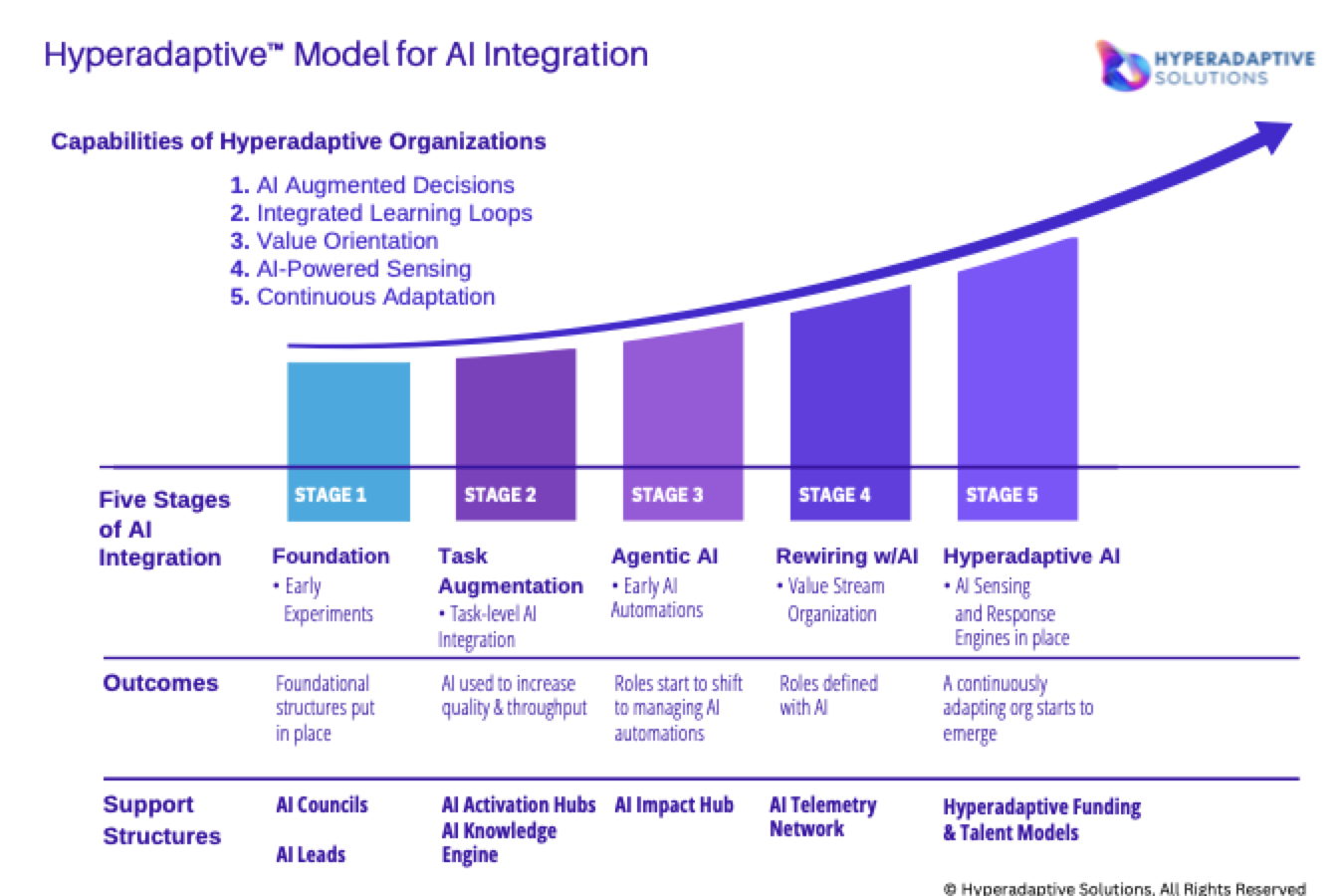
The capabilities that outlast today's models
- AI Augmented Decisions
- Integrated Learning Loops
- Value Orientation
- AI-Powered Sensing
- Continuous Adaptation
Underneath the five stages are five capabilities: AI Augmented Decisions, Integrated Learning Loops, Value Orientation, AI-Powered Sensing, and Continuous Adaptation.
Two of them have AI in the name today. The capability underneath is older than AI and will outlast it. An organization that senses what's changing, decides on the best information it has, learns as a system and adapts on purpose is ready for the next thing, whether that's a better model, quantum, or something nobody has named yet.
That's the durable part, and it's the reason I'd still stand behind this model if the word 'AI' fell out of use tomorrow.
Where the model comes from
I didn't invent the idea that an organization has to learn. Walk into a bookstore in 1990 and Peter Senge's The Fifth Discipline is on the table next to John Kotter's Leading Change. Chris Argyris had already given us double-loop learning in the 1970s. Frederick Taylor gave us the one best way, which is the thing all of them were arguing with.
What the model builds on, and from whom:
- Peter Senge
- The learning organization, and systems thinking
- John Kotter
- Change as something you lead, not announce
- Chris Argyris
- Double-loop learning: questioning the rule, not just the result
- Clayton Christensen
- Why successful companies fail. They invest in what worked last time
- Edgar Schein
- The two fears that fight each other whenever people are asked to change
- Amy Edmondson
- People who are afraid of making mistakes don't run experiments
- Karl Weick
- Organizational sensing
- Nonaka and Takeuchi
- How tacit knowledge becomes something the whole company can use
- O'Reilly and Tushman
- How an organization runs at several speeds without tearing
None of them had AI in mind. They were describing how organizations learn and change, which doesn't go out of date when the technology does. The model points their arguments at AI and tests them against the organizations I work with, and every one of them is cited in the book.
The lineage in full →Is it the technology or the organization?
3 in 4
Nearly three-quarters of AI high performers say they've fundamentally redesigned workflows because of AI, against one quarter of everyone else. Source: McKinsey, The State of AI, Aug 2026 (1,719 respondents, 97 countries)
59% of organizations take a tech-focused approach to AI, and those that do are 1.6x more likely to miss their return expectations than the ones taking a human-centric approach. Source: Deloitte Human Capital Trends 2026 (from a companion study of 100 C-suite leaders)
BCG tells its clients to put 10% of the effort into algorithms, 20% into data and technology, and 70% into people, process and culture. That's a prescription rather than a measurement, and it came from a firm many of these buyers already hired. Source: BCG, Jan 2025
The evidence points the same direction every time. None of these studies proves that the people doing the work have to be the ones who redesign it. That part is my argument, and I'll name it as mine.
Start here
Give the layer a name and a rhythm
Your champions volunteered. The AI work sits on top of their day job, and nothing says what it's for.
Your AI leads have a named role, a hub they report into, and a standing rhythm for handing what worked in one function to the next.
Where to start
You don't build this in one go, and you shouldn't try. Every program builds one working piece of the layer, your own people run that piece, and the next piece gets easier.
Designed by Melissa Reeve, delivered by a Hyperadaptive delivery partner.
Questions about the Hyperadaptive Model
- What is the Hyperadaptive Model?
- An AI operating model. It names the network of people who carry AI learning, governance and the agent lifecycle across an organization, the nine dimensions that have to move together, the five stages they move through, and the five capabilities that result. It comes from Melissa Reeve's book Hyperadaptive: Rewiring the Enterprise to Become AI-Native (IT Revolution, 2026).
- What is an activation layer?
- The layer between your AI strategy and the people doing the work: AI leads inside each team, activation hubs that serve a business area, and interpreters who translate what's new into what it means here. Software helps. The layer itself is people and rhythms.
- What are the nine dimensions?
- AI Impact, Linear Organization, Organizational Structure, Budgeting & Incentives, Leadership, Roles, Sensing, Decision-Making, and Adaptation & Learning. The Terrain Read scores an organization on all nine so you can see which one is holding the others back.
- What are the five stages of AI integration?
- Foundation, Task Augmentation, Agentic AI, Rewiring with AI, and Hyperadaptive AI. Each stage needs different support structures underneath it.
- Does this only apply to AI?
- No. The five capabilities it builds are about sensing, deciding, learning and adapting. AI is what makes them urgent right now. They're what an organization will need for whatever arrives after today's models.
- How is this different from an AI center of excellence?
- A center of excellence concentrates expertise in one group. The activation layer distributes it, so each business area has someone close enough to the work to make the call. Most organizations keep the center of excellence and build the layer around it.